
|
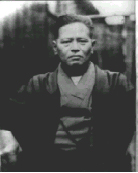 |
The origin of Karate-Do can be traced back to the Buddhists monks traveling from India where it spread throughout China and through the merchant traders to Okinawa. The martial arts of Okinawa had developed into three main regional styles, namely Shuri-te, Tomari-te and Naha-te. The latter was the basis of the Goju system. Master Kanryo Higaonna (1853-1915), the highest authority in Naha-Te, went abroad to the Chinese city of Fuchou, where he studied Chinese boxing for approximately 15-20 years. |
 |
Chojun
Miyagi (1888-1953), founder of Goju-Ryu, had started studying Karate at
eleven years of age. When Miyagi was fourteen, Master Higaonna accepted
him as a student. Miyagi Sensei studied under Higaonna until his master’s
death in 1915. Miyagi traveled on two occasions after Higaonna’s
death to China retracing his master’s previous visits.
Goju-Ryu Karate-Do derived from two contrasting terms - GO (hard) and JU (soft) was the first organization to be considered a style. It is said to have come from the third precept below that ‘The way of inhaling and exhaling is hardness and softness’. |
Gogen Yamaguchi (1909-1989) was born on January 20, 1909, in Kagoshima city southern Kyushu. During his early school days, he began training under Murata, a Goju exponent from Okinawa. Later as a law student, Yamaguchi established his first Karate club at the Ritsumeikan University in Kyoto. It was during this period that Yamaguchi created the first stages towards what is known as Jiyu Kumite (free sparring) and established rules to decide the winner of a match. |
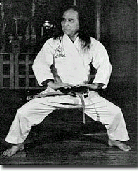 |
In
1931, at the age of 22, Gogen Yamaguchi was introduced to the founder
of the Goju style, Master Chojun Miyagi. The meeting proved to have a
profound affect upon Yamaguchi’s outlook on Karate. Previously,
he had only considered the hard aspect of Goju but after his meeting with
Master Miyagi, he was determined to train himself both spiritually and
physically. Master Miyagi thought highly of Yamaguchi who seemed to have
mastered the hard aspect of Goju so well and gave him the nickname of
Gogen meaning ‘Rough’. He then appointed Gogen Yamaguchi as
his successor of the Goju school in Japan.
Master Yamaguchi’s contributions to Goju-Kai Karate-Do and to Karate in general have been enormous. Under his leadership, the International Karate-Do Goju-Kai Association (IKGA) has emerged. The organization has increased in popularity both in Japan and other Asian and Western countries around the world. Master Gogen Yamaguchi,
10th Dan Black Belt, a man of intense dedication and determination can
truly be considered the last of the Karate legends. A master of Yoga
and Shinto priest, a man that has truly united both aspects of GO and
JU into a concerted union. Master Gogen Yamaguchi past away in 1989
at the age of 81 years of age. The legacy of Goju-Kai Karate-Do has
now been handed to his son Master Goshi Yamaguchi. |
| Quick Navigation >>>> |
 |

|

|

|

|
 |